
What This Experience Invites Us to Notice
Following the Shadow: A Practical Guide to Documenting, Revisiting, and Extending Children's Theories.

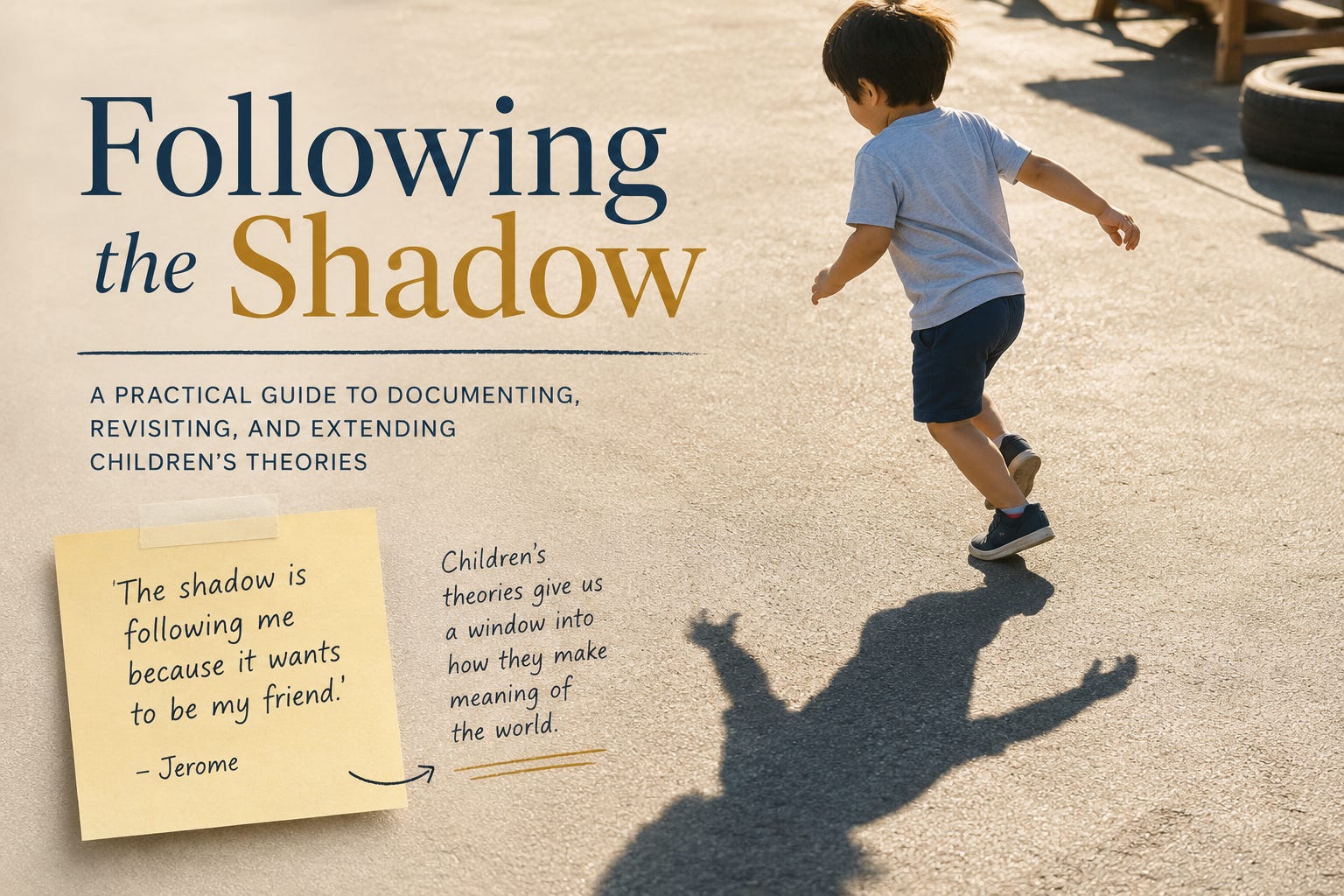
This is a continuation of this week’s Chronicles of Children’s Thinking post, offering reflective strategies, examples, and invitations to help you deepen your understanding and application of children’s thinking in everyday practice.
When Jerome said, “The shadow is following me because it wants to be my friend,” he wasn’t simply making a statement. He was constructing a theory to explain something he observed. Like all children, Jerome was drawing upon his experiences, relationships, observations, and imagination to make sense of the world.
Too often, when children share theories, we as adults feel responsible for providing answers. We explain, correct, and teach. Yet in doing so, we may unintentionally interrupt the very process that drives deep learning: theory building.
What if, instead of rushing to explain, we treated children’s theories as invitations for investigation?
Jerome’s shadow offers us a powerful example.
Step 1: Listen for the Theory
When Jerome noticed his shadow following him around the playground, he became fascinated and began to investigate. He walked a few steps and noticed that the shadow walked too. He ran across the yard, and the shadow ran alongside him. When he stopped, the shadow stopped.
Over and over, Jerome tested what he was observing, carefully watching the relationship between his movements and the dark shape that seemed to stay by his side. After gathering what he believed was enough evidence, Jerome confidently announced, "The shadow is following me because it wants to be my friend." This statement was much more than a cute comment. It was a theory.
Jerome was attempting to explain a phenomenon that intrigued him by drawing upon something he already understood: friendship. From his perspective, friends stay close, spend time together, and rarely leave their side.
By connecting his observations to his experiences with relationships, Jerome was constructing meaning and making sense of the world around him. The first step in supporting children's thinking is learning to recognize these moments for what they truly are—not random comments but thoughtful theories that reveal how children interpret their experiences and build understanding.
Ask yourself:
What is the child trying to explain?
What patterns has the child noticed?
What experiences might be influencing their thinking?
What theory is hidden inside their words?
When we begin listening closely, we discover that children are constantly constructing explanations about how the world works.
Step 2: Slow Down Before Explaining
Our instinct is often to replace a child's theory with information. When Jerome said that his shadow wanted to be his friend, we might have been tempted to respond, "Actually, shadows are created when light is blocked." While that explanation may be accurate, it could also close the door on Jerome's investigation before we fully understand his thinking. I also think it stops that magnificent, magical feeling that Jerome was experiencing.
Instead, we can respond with curiosity by asking, "What makes you think your shadow wants to be your friend?" or "What have you noticed about your shadow?" We might also wonder with him, "Does it always follow you?" These kinds of questions invite children to think more deeply about their observations, gather more evidence, and stay connected to their own process of meaning-making.
More importantly, they communicate something powerful:
Your thinking matters.
The goal is not to avoid scientific explanations. The goal is to create space for children’s ideas before introducing our own.
Step 3: Make the Thinking Visible
Children’s theories are often fleeting. Without documentation, they can disappear as quickly as they emerge. Capture the moment.
You might:
Photograph Jerome exploring his shadow.
Record his exact words.
Document the actions that led to his theory.
Write down your observations of his investigation.
Most importantly, preserve the child’s language. Rather than documenting:
“Jerome learned about shadows.”
Document:
“The shadow is following me because it wants to be my friend.”
Children’s words reveal how they are making meaning. They offer a window into their thinking that no checklist or assessment can capture.
Step 4: Look Beneath the Theory
At first glance, Jerome's theory appears to be about shadows. However, when we listen more carefully to his words, we discover that his theory is rooted in something much deeper than the movement of light and dark.
Jerome drew on his understanding of relationships, friendship, connection, and belonging to explain what he observed. From his perspective, friends stay close to one another, spend time together, and rarely leave each other's side. Because his shadow followed him wherever he went, it made perfect sense to conclude that the shadow wanted to be his friend.
When we look beneath children's theories, we often uncover the larger ideas they are exploring and trying to understand. The shadow was not simply a shadow; it became a way for Jerome to think about companionship, connection, and relationships.
By paying attention to these deeper meanings, we gain valuable insight into children's thinking and can create investigations that honor their theories, nurture their curiosity, and support them in constructing their own understanding rather than simply receiving facts from adults.
Step 5: Revisit the Theory
This is where learning begins to deepen.
A day later, a week later, or even a month later, return to the documentation.
Show Jerome the photographs.
Read back his words.
Invite him to revisit his thinking.
You might ask:
What do you remember about your shadow?
Do you still think it wanted to be your friend?
What new things have you noticed?
Has your theory changed?
Revisiting allows children to compare earlier ideas with new experiences.
It helps them see learning as an evolving process rather than a search for the right answer.
Step 6: Invite Collective Thinking
What happens when Jerome's theory becomes part of a larger conversation within the learning community? Imagine displaying a photograph of Jerome exploring his shadow alongside his words, "The shadow is following me because it wants to be my friend." As other children encounter the documentation, they may begin sharing their own observations and theories. One child might say, "My shadow follows me too," while another notices, "Mine gets really big when the sun is low."
Another child may wonder, "Sometimes my shadow disappears." What began as one child's theory suddenly expands into a collective investigation. Children start comparing experiences, noticing similarities and differences, building upon one another's ideas, and generating new questions.
Through these conversations, they are not only exploring shadows but also learning how to listen to multiple perspectives, negotiate meaning, and construct knowledge together. The investigation becomes richer because it is no longer held by a single child. Instead, it becomes a shared journey of inquiry where learning is collaborative, relationships are strengthened, and children's thinking becomes visible to the entire community.
Step 7: Follow the Questions
When children’s theories become visible, new possibilities emerge.
Inspired by Jerome’s investigation, children might:
Trace their shadows at different times of the day.
Compare shadow sizes in the morning and afternoon.
Photograph shadows around the playground.
Create stories about where shadows go.
Notice how shadows change when clouds move overhead.
Explore what happens when two shadows meet.
The goal is not to lead children toward a predetermined lesson about light and shadow.
The goal is to nurture dispositions that support lifelong learning:
Wondering
Observing
Predicting
Investigating
Reflecting
Revising ideas
These are the habits of thinkers, researchers, and innovators.
An Invitation to Notice
This week, pay attention to the shadows. Notice when children stop to observe them, follow them, talk to them, or wonder about them. Listen carefully to the theories they share and resist the urge to rush toward an explanation. Instead, document their words, photograph their investigations, and preserve the moments that reveal how they are making meaning of what they observe. Then return to those ideas a few days later and invite children to think again. What do they remember? What new observations have they made? Has their theory changed or expanded?
As you engage in this process, consider the following question: What might happen if I treated a child’s theory not as a misconception to correct, but as a journey worth revisiting? Jerome’s shadow may or may not have been his friend, but his theory offered something far more valuable than an explanation of shadows. It offered a glimpse into his thinking, revealing how he drew on his understanding of friendship and relationships to make sense of an intriguing phenomenon. When we chronicle, revisit, and honor children’s theories, we communicate a powerful message: Your ideas matter. Your theories are worthy of investigation. Your thinking is worth remembering.
Join the Conversation
I would love to hear from you. What is the most memorable theory a child has shared recently?
Perhaps it was about a shadow, a puddle, an insect, a friendship, the moon, or something entirely unexpected.
What explanation did the child construct?
What were they trying to understand?
Share the child's exact words in the comments. Together, we can create a collective chronicle of children's theories and celebrate the extraordinary ways children observe, question, interpret, and make meaning of the world around them.