
Not Just a Stick: Looking Beyond the Object
A continuation of this week's Chronicles of Children's Thinking post, offering reflective strategies, and invitations to help you deepen your understanding of children's relationships with objects.

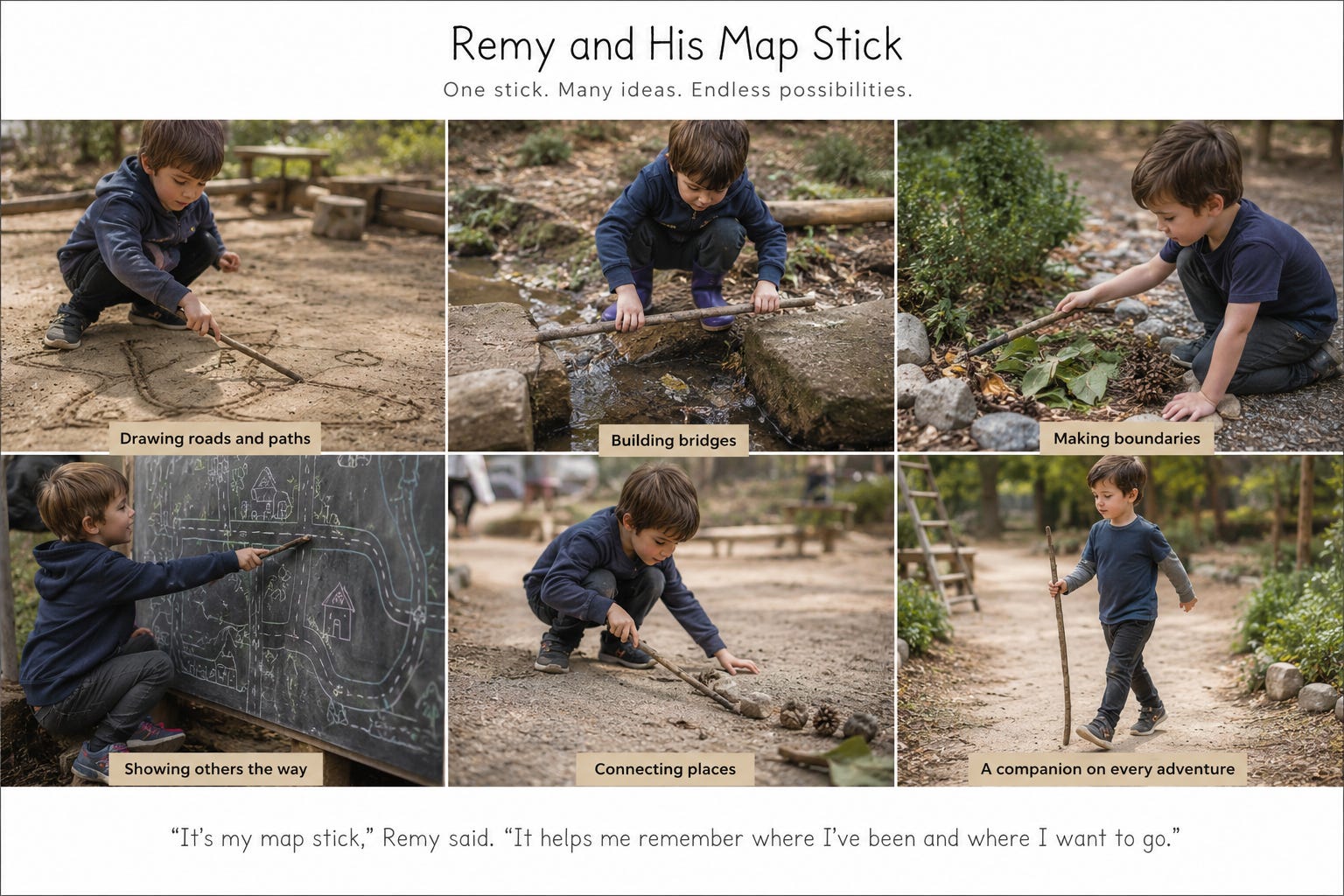
Revisiting the Stick Nobody Was Allowed to Touch
At first, the stick seemed to be the problem.
Remy carried it everywhere he went. He became upset when another child touched it. If it was misplaced, he would search for it with great determination. When adults offered him another stick, even one that appeared nearly identical, he rejected it. To those observing from the outside, his attachment seemed puzzling. Conversations naturally gravitated toward concerns about possession, flexibility, and whether his reliance on the stick was preventing him from engaging more fully with other possibilities.
It would have been easy to stop there.
It would have been easy to see the stick as something that needed to be managed.
But revisiting asks us to return to moments we think we understand and look again. It invites us to slow down, suspend our certainty, and consider that what first appears obvious may not tell the whole story.
As educators revisited their observations of Remy, a different question began to emerge. Rather than wondering why he was so attached to the stick, they began wondering what the stick might be making possible.
That shift changed everything.
As conversations with Remy unfolded and documentation was revisited, the stick began to reveal a story that had been hidden in plain sight. The stick was not simply an object he carried from place to place. It was a tool he used to think. It helped him create roads in the dirt, connect locations across the playground, mark significant places, and retrace journeys he had taken. The stick served as a way to represent ideas that were larger than words.
The stick, Remy explained, was a map.
Suddenly, what had appeared to be attachment looked very different. What adults initially interpreted as possessiveness was actually purpose. What seemed like rigidity was an investigation. The stick was supporting a complex exploration of pathways, connections, memory, and place.
The object itself had never been the story.
The story was the thinking.
This experience reminded us how often children use materials as languages for exploring ideas. A treasured rock may hold a theory about collection and classification. A blanket may support an exploration of comfort, identity, or belonging. A cardboard box may become a vehicle for imagining possibilities that do not yet exist. Children often choose materials not because of what the materials are, but because of what the materials allow them to think about.
When we focus only on the object, we risk missing the ideas it carries.
Looking back, one of the most significant lessons from revisiting Remy’s experience was recognizing how easily adult interpretations can narrow our view. Initially, the conversation centered on the behavior. Why was he carrying the stick? Why was he upset when others touched it? Why wouldn’t he choose another one?
These questions were understandable, but they kept our attention fixed on the surface of the experience.
Only when we revisited the moment did we begin to see what lay beneath it.
The stick was helping Remy represent relationships between places. It was helping him remember where he had been and imagine where he might go. It allowed him to make his thinking visible in ways that spoken language alone could not yet accomplish.
What if we had taken it away?
That question lingers.
How many investigations have been interrupted because adults misunderstood the role a material was playing in a child’s thinking? How many theories remain invisible because we focus on managing the object rather than understanding the relationship?
Revisiting reminds us that children’s ideas are often hidden inside ordinary moments. The challenge is not simply to observe those moments but to return to them. To look again. To listen again. To consider new possibilities for interpretation.
Remy’s stick was never really about a stick.
It was about mapping a world.
It was about making sense of relationships, places, journeys, and connections.
Most importantly, it reminds us that when we revisit children’s experiences with curiosity, we often discover that what first appeared ordinary was carrying an extraordinary idea all along.